
Medically reviewed by Dr. Robert Rubin, MD. Last reviewed October 2026.
Dr. Robert Rubin offers Testosterone Replacement Therapy at two locations in Florida:
Telemedicine appointments are available for patients across Florida, including the Tampa Bay Area, South Palm Beach, and North Broward.
Testosterone is a vital male sex hormone responsible for the development of reproductive organs, secondary sexual characteristics — muscle mass, bone density, body hair — and ongoing regulation of energy, mood, sexual function, and metabolism throughout a man's life. As men age, testosterone levels decline naturally. When production drops below certain levels, the effects on quality of life can be significant.
Testosterone Replacement Therapy (TRT) restores hormonal balance using bioidentical testosterone — matched to the body's own physiologic pathways — in men who have confirmed low testosterone. Low libido is typically the first presenting symptom. Restoring normal levels reliably improves sexual drive, erectile function, bone density, body composition, mood, and mental clarity. Some men notice a difference within days; many benefits develop over three to twelve months of consistent treatment.
TRT can help address the following symptoms:
Many of these symptoms overlap with other conditions — including depression, sleep apnea, thyroid disease, obesity, and medication side effects. This is why low testosterone should never be diagnosed, or TRT initiated, on symptoms alone. Dr. Rubin requires consistently low morning testosterone levels measured with appropriate testing alongside the symptom profile before recommending treatment. Starting TRT without that confirmation risks treating the wrong condition entirely.
Most "low T clinics" test your testosterone level, confirm it's low, and prescribe. Dr. Rubin's approach starts there and goes further — identifying why your testosterone is low and whether replacement is the right intervention or whether something else should be addressed first.
Dr. Rubin uses extended hormone panels measuring total, free, and bioavailable testosterone alongside sex hormone binding globulin (SHBG), estradiol, DHEA-S, and prolactin. He also assesses metabolic and inflammatory markers — fasting insulin, cortisol rhythms, and high-sensitivity C-reactive protein (hs-CRP) — to identify hidden drivers of low testosterone like inflammation or insulin resistance. He also screens for contributing conditions such as thyroid dysfunction or hypogonadism from testicular injury.
Medical weight loss can be highly effective before or alongside TRT — reducing body fat lowers aromatase activity, which otherwise converts testosterone into estrogen. Nutritional support corrects deficiencies in Vitamin D, magnesium, and zinc that impair testosterone production. Stress management and sleep improvement address cortisol dysregulation, which suppresses testosterone when chronically elevated.
Gut dysfunction affects hormone balance through multiple pathways. Dr. Rubin evaluates overall microbiome health, digestive function, stomach acid, gut motility, and inflammatory markers as part of the hormone optimization picture.
Endocrine-disrupting chemicals — found in plastics, pesticides, and many personal care products — suppress testosterone production. Identifying and reducing exposure is a meaningful and often overlooked intervention.
When replacement is indicated, Dr. Rubin uses bioidentical testosterone formulated to match the body's physiologic pathways. Delivery method is customized to your lifestyle, preference, and clinical profile.
Available options include:
The right delivery method depends on your lifestyle, how consistently you'll use it, and how your body responds. Dr. Rubin will discuss the options at your consultation.
Ongoing monitoring of symptoms, metabolic function, and related hormones including DHT and estradiol is essential to maintaining hormonal balance and preventing the overconversion of testosterone to estrogen that can occur with poorly supervised TRT.
It depends on what you're looking for. Mood improvements can begin as early as three to six weeks. Energy typically improves after three months. Body fat redistribution, increased facial and body hair, and changes in mental state generally take three to six months. Meaningful increases in muscle mass and strength typically require six to twelve months of consistent treatment.
A single injection lasts anywhere from a few weeks to 10-12 weeks depending on the formulation used. TRT is designed as a long-term therapy — if you stop, testosterone levels return to baseline. Duration of individual doses varies based on your metabolism and prescribed dosage.
Frequency depends on delivery method. Injections range from weekly to every 10-12 weeks. Gels and patches are applied daily. Pellets are implanted every three to six months. Dr. Rubin will match the schedule to your lifestyle and clinical needs.
Most men experience little to no discomfort. The injection site is thoroughly cleaned and disinfected before a small needle delivers the solution into the muscle. Sessions take only a few minutes once established.
TRT is generally considered safe when used appropriately in men with confirmed low testosterone and proper medical supervision. Dr. Rubin reviews your full medical history and risk profile before recommending treatment and monitors your response throughout. Potential risks and benefits are discussed in detail at your first consultation.
Yes. TRT is frequently one component of a broader men's health or functional medicine plan. It works alongside medical weight loss, P-Shot, shockwave therapy, and peptide therapy depending on what your evaluation surfaces. The plan is built around your specific drivers, not a standard protocol.
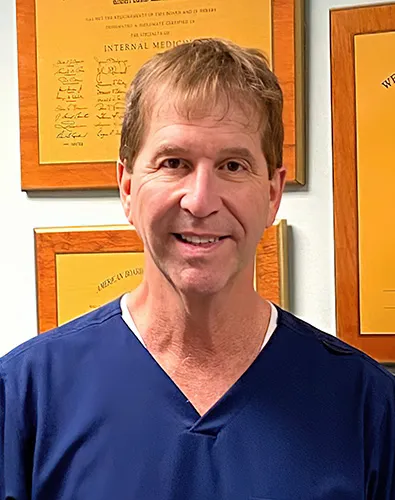
Dr. Rubin is ABIM Board Certified in Internal Medicine and Geriatrics Medicine and an Advanced Fellow in the American Academy of Anti-Aging Medicine. He has extensive experience treating men with low testosterone and hormone-related conditions at his clinics in Naples and South Tampa.
He spent the first 25 years of his career in internal and geriatric medicine, earning recognition from Castle Connolly Medical as one of the "Top Doctors" in South Florida for four consecutive years. After completing a fellowship in anti-aging and regenerative medicine, he transitioned to functional medicine — building a practice that identifies what is actually driving a patient's hormone decline rather than treating the lab number alone.
Free consultations are available at both clinics and via telemedicine for patients anywhere in Florida.
Naples
840 111th Avenue North, Suite 5, Naples, FL 34108
(239) 977-9220
TRT in Naples →
South Tampa
405 N. Reo St., Suite 162, Tampa, FL 33609
(813) 499-1440
TRT in South Tampa →
